


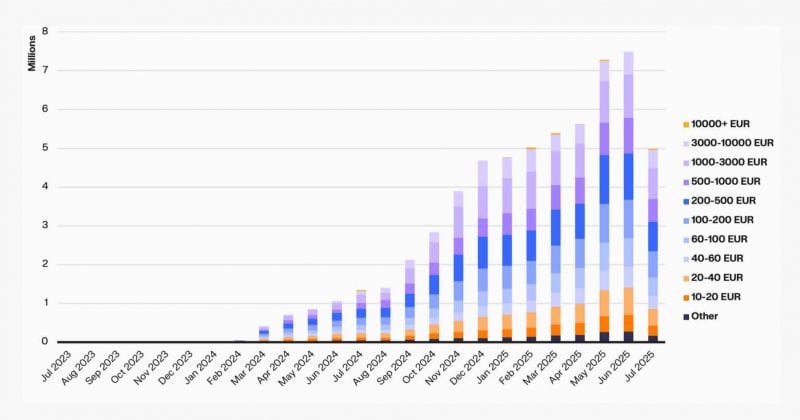
The euro stablecoin market is tiny. At roughly €620 million in total market capitalization, euro-denominated stablecoins account for about 0.2% of the global stablecoin landscape. But the trajectory underneath that small number is turning heads.
Issuers of EUR-pegged stablecoins are reporting a surge in inbound requests from entrepreneurs and institutions eyeing what they see as a largely untapped opportunity in a €16 trillion market. The catalyst is straightforward: MiCA finally gave the space a rulebook, and capital is responding.
A 1,200% volume spike tells the story
Transaction volume for MiCA-compliant euro stablecoins has jumped 1,200% since the regulation took effect. It reflects a massive migration of activity from unregulated tokens to issuers that meet the EU’s new reserve management and compliance standards.
Circle’s EURC has been the primary beneficiary of this shift, capturing over 50% of the euro stablecoin market. Circle was among the first to align its operations with MiCA’s requirements, giving it a first-mover advantage in a compliance-driven market where trust is the product.
Investor confidence in EU stablecoins has climbed nearly 50%, driven largely by the controlled reserve management and transparency obligations that MiCA imposes.
Why the €16 trillion number matters
The €16 trillion figure represents the broader euro-denominated market opportunity, encompassing cross-border payments, trade finance, and the vast pool of euros that move through traditional financial infrastructure daily. Euro stablecoins already contribute nearly 13% to global payments activity, serving as a bridge between traditional finance and DeFi ecosystems.
A €620 million market cap serving a €16 trillion addressable market means current penetration is essentially a rounding error. Even modest adoption gains from here would represent enormous growth in absolute terms.
The profitability puzzle
Not everything about MiCA is a tailwind for issuers. The regulation’s stringent reserve requirements create real constraints on how issuers can generate yield from the assets backing their tokens. Traditional stablecoin issuers have historically earned revenue by investing reserves in short-term government securities and other low-risk instruments. MiCA’s rules around reserve composition and management limit that flexibility, which compresses margins.
What this means for investors
For DeFi protocols and exchanges, euro stablecoin liquidity has been a persistent bottleneck. As compliant issuers scale, that liquidity should improve, potentially unlocking new trading pairs, lending markets, and yield opportunities denominated in euros rather than dollars.
Circle’s EURC dominance at over 50% market share gives it significant network effects, but the regulatory clarity that MiCA provides also lowers the barrier for new entrants who can meet compliance standards. The 1,200% volume growth is impressive, but it’s growth off a small base in a market that’s still finding its footing.