


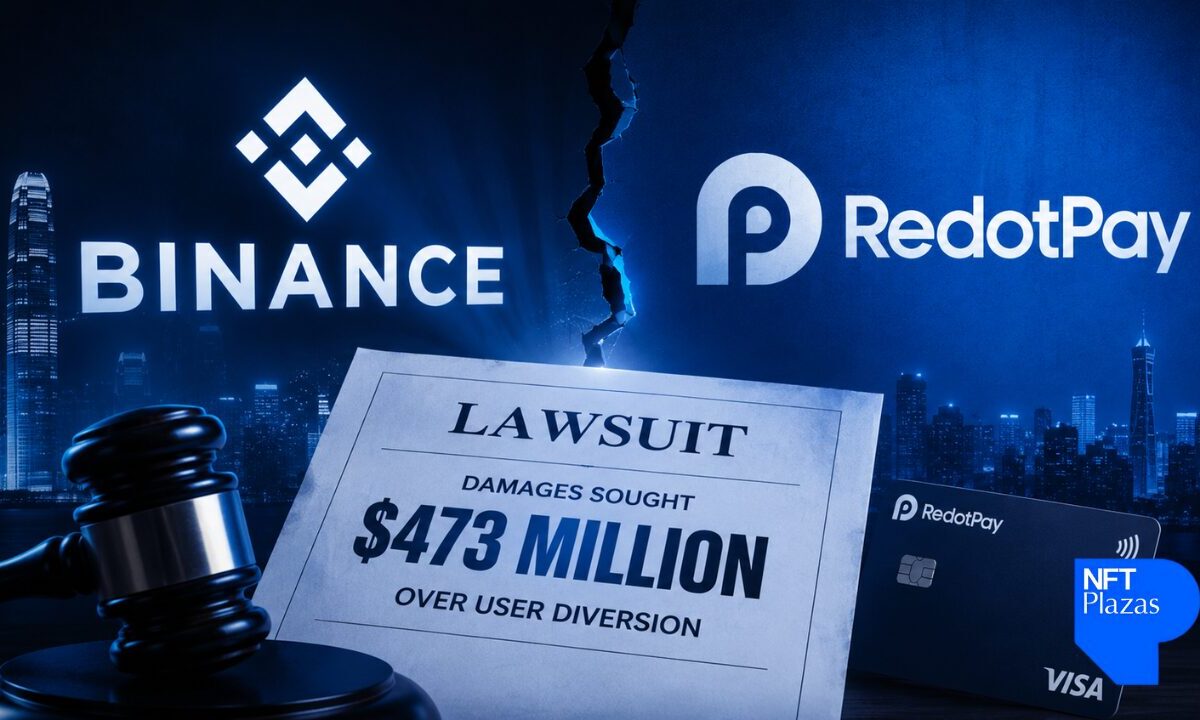
Binance-affiliated companies have launched a high-profile legal battle against stablecoin payments provider RedotPay, accusing the firm and its co-founders of improperly diverting nearly half a million Binance users in violation of commercial agreements. The lawsuit, filed in Hong Kong, seeks approximately $472.8 million in damages, marking one of the most significant legal disputes to emerge in the rapidly expanding crypto payments sector.
The case arrives at a pivotal moment for RedotPay, which has been expanding aggressively in the stablecoin payments market while reportedly preparing for a potential U.S. initial public offering. Although Binance alleges that RedotPay built part of its growth by exploiting access to Binance Pay users, the payments company has firmly denied all accusations and says the litigation will not disrupt its operations.

Binance Affiliates Sue RedotPay Founders for $473 Million Over User Diversion (Source: X)
Binance claims RedotPay breached commercial agreements
According to court filings cited by Bloomberg, Binance affiliates Nest Trading, DistributedTechnologies, and Chaintecs Consulting Singapore accuse RedotPay of violating contractual restrictions governing the use of Binance Pay.
The plaintiffs allege that beginning in March 2026, RedotPay enabled and encouraged users to fund RedotPay payment cards directly through Binance Pay in ways explicitly prohibited under their partnership agreements. Binance argues that this practice effectively redirected customers away from Binance’s own ecosystem and toward RedotPay’s competing payment infrastructure.
The exchange estimates that more than 470,000 Binance customers migrated through this mechanism. Using an estimated lifetime customer value of $925 per user, Binance calculated damages of nearly $473 million.
In addition to lost customer value, Binance alleges that roughly $304 million in Binance Pay user assets flowed into the RedotPay ecosystem through the disputed funding mechanism, further strengthening its claim that the company benefited financially from the alleged contractual violations.
Binance has declined to discuss the specifics of the ongoing litigation publicly but stated that it intends to pursue all available legal avenues to protect its commercial interests.
Parallel lawsuits in Hong Kong and Singapore
The legal conflict extends beyond Hong Kong.
Alongside the primary lawsuit, Binance affiliate Chaintecs Consulting Singapore has initiated related legal proceedings in Singapore against entities connected to RedotPay and its co-founders, including Gao Zhangpeng, Chan Wa Choi, and Yao Chao. A hearing in the Singapore case is reportedly scheduled to take place this week.
The coordinated litigation across multiple jurisdictions underscores how seriously Binance appears to be treating the dispute, particularly given the international nature of both companies’ payment operations.
RedotPay rejects every allegation
RedotPay has responded by categorically denying Binance’s claims.
In an official statement, the company said it is fully aware of the legal proceedings and intends to “vigorously defend” itself against what it describes as unfounded allegations.
The firm also emphasized that the lawsuits will have no impact on its day-to-day operations, reassuring customers and business partners that services will continue uninterrupted while the courts consider the case.
Despite the legal challenge, RedotPay highlighted the continued growth of its business. According to the company, its global user base has expanded by more than 33% over the past six months, surpassing 8 million users worldwide. It also reported approximately $180 million in annualized revenue and around $14 billion in annualized payment volume, illustrating its rapid emergence as one of the largest stablecoin payment card providers globally.
A partnership that unraveled
The dispute stems from a commercial relationship that began in late 2023, when RedotPay integrated Binance Pay into its crypto payment card platform.
At the time, the collaboration allowed Binance Pay users to transfer funds directly onto RedotPay-issued payment cards, making it easier for customers to spend cryptocurrencies and stablecoins in everyday transactions.
However, Binance says the original partnership quickly encountered problems after it concluded that customer funds were being used for activities outside the agreed framework. The initial agreement reportedly collapsed within six months.
The companies later negotiated a new agreement in March 2025, introducing stricter safeguards requiring Binance Pay assets to remain fully segregated.
Under the revised arrangement, Binance customers could use Binance Pay on RedotPay only for specific purposes, including converting crypto into fiat currency, making in-app transfers, and purchasing RedotPay-branded products. Direct funding of RedotPay payment cards remained expressly prohibited.
According to Binance, further violations were discovered during a review of payment partners, ultimately leading the exchange to terminate the partnership in April 2026.
IPO ambitions raise the stakes
The lawsuit arrives at a particularly sensitive time for RedotPay.
The company has reportedly been exploring a U.S. IPO that could raise more than $1 billion and value the business at over $4 billion, with major investment banks including JPMorgan, Goldman Sachs, and Jefferies advising on the potential listing.
Bloomberg reported that Binance argues the alleged diversion of customers directly contributed to RedotPay’s corporate value as it prepares for public markets. If proven in court, the allegations could become a significant issue for investors evaluating the company’s growth trajectory and customer acquisition practices.
A closely watched case for crypto payments
Beyond the financial claims, the dispute highlights growing tensions surrounding partnerships between crypto exchanges and payment providers as stablecoin adoption accelerates worldwide.
Binance Pay has become an increasingly important component of Binance’s broader ecosystem, while RedotPay has positioned itself as one of the fastest-growing issuers of crypto-linked payment cards. The lawsuit therefore raises broader questions about how customer access, payment integrations, and commercial restrictions should be governed as digital asset payment networks become more interconnected.
For now, both sides remain firmly committed to defending their positions in court. With proceedings underway in both Hong Kong and Singapore, the outcome could influence not only RedotPay’s expansion plans and prospective IPO, but also how future partnerships between crypto exchanges and payment companies are structured across the industry.