


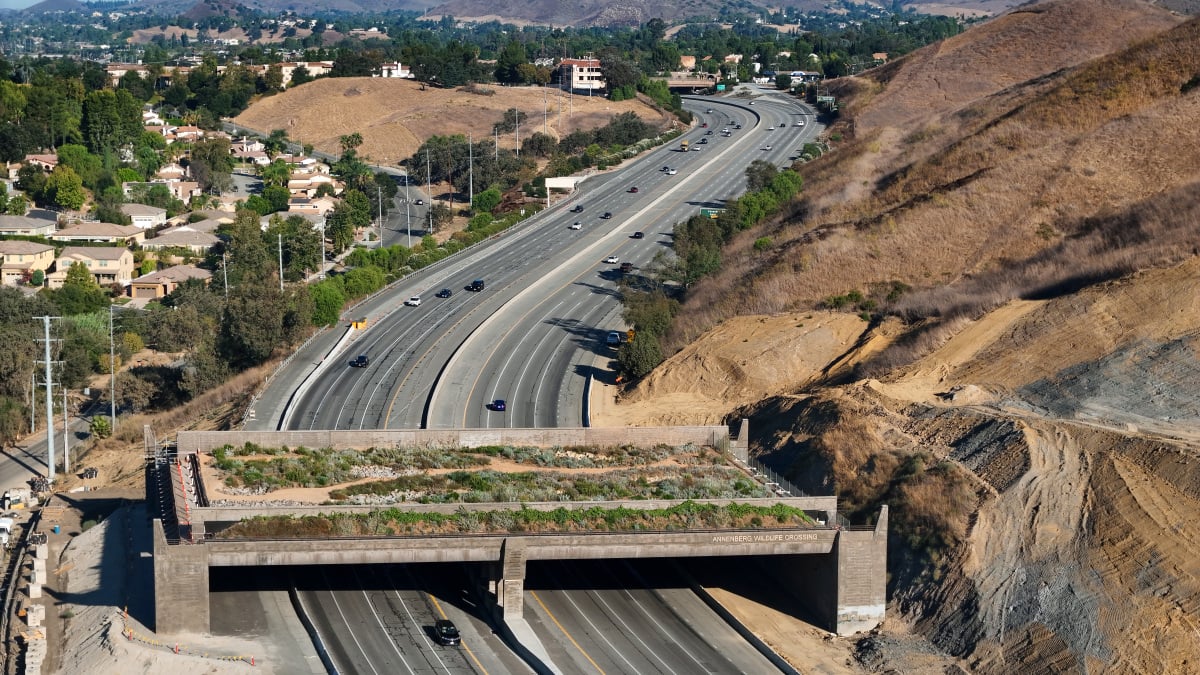
Soon California drivers speeding down the 101 freeway won’t be the only ones commuting in comfort. As hundreds of thousands of vehicles speed down the multi-lane highway in their vehicles, their animal counterparts — the wildlife population that makes up Los Angeles County — will be similarly at ease.
That’s because officials will finally unveil the completed Wallis Annenberg Wildlife Crossing, a large, vegetated overpass that will help animals cross traffic safely and comfortably move across the land split by zooming cars. It is the world’s largest wildlife crossing in the world.
What is the Wallis Annenberg Wildlife Crossing?
The bridge connects the Santa Monica Mountains to the Simi Hills and spans 10 lanes of traffic, plus an access road. The project has been in the works for 10 years — one part of a nationwide scientific monitoring program led by partners like the National Wildlife Federation, the Mountains Recreation and Conservation Authority, and the National Park Service.
The crossing was funded by a public-private partnership, with government funds and philanthropic donations providing the money.
The crossing is hoped to be a boon to local wildlife populations, which often meet deadly fates from cars speeding along the state highway, but also face geographic and genetic isolation due to the freeway’s barrier-like effect. Mountain lions, coyotes, bobcats, deer, and various bird, lizard, and snake species are expected to traverse the path to cross the freeway and find more land to roam and mate.
Mashable Light Speed

Credit: Kayla Bartkowski / Contributor / Los Angeles Times via Getty Images
How to view the Wallis Annenberg crossing trail cams
Over the last week, biologists have been installing a series of wildlife cameras near the Wallis Annenberg Wildlife Crossing in the Santa Monica Mountains National Recreation Area to track animal populations before the crossing officially opens on Dec. 2. By the time of opening, scientists and nature watchers will be able to monitor its visitors via 50 cameras and four thermal video cameras.
Project leads told the Los Angeles Times that the cameras’ photo stream will be available to the public. For now, live video feeds will only be available to researchers for security reasons.
The cameras are already picking up hopeful moments, including the path’s first visitor: A single coyote trotting up the side of the currently unfinished path, shielded by the cover of night and the lack of blinding headlights.
The sighting marveled scientists working on the project, who expected a smaller animal to attempt the cross first.
“I wouldn’t have said this even a couple weeks ago, but I now think there’s a chance we’ll have a mountain lion use it before ribbon cutting,”said Beth Pratt of the Wildlife Crossing Fund to the Los Angeles Times. “Word gets out in the animal world, so who knows what’s going to happen?”
What did we say? Millennial optimism is really back.
Topics
Social Good
Outdoors