


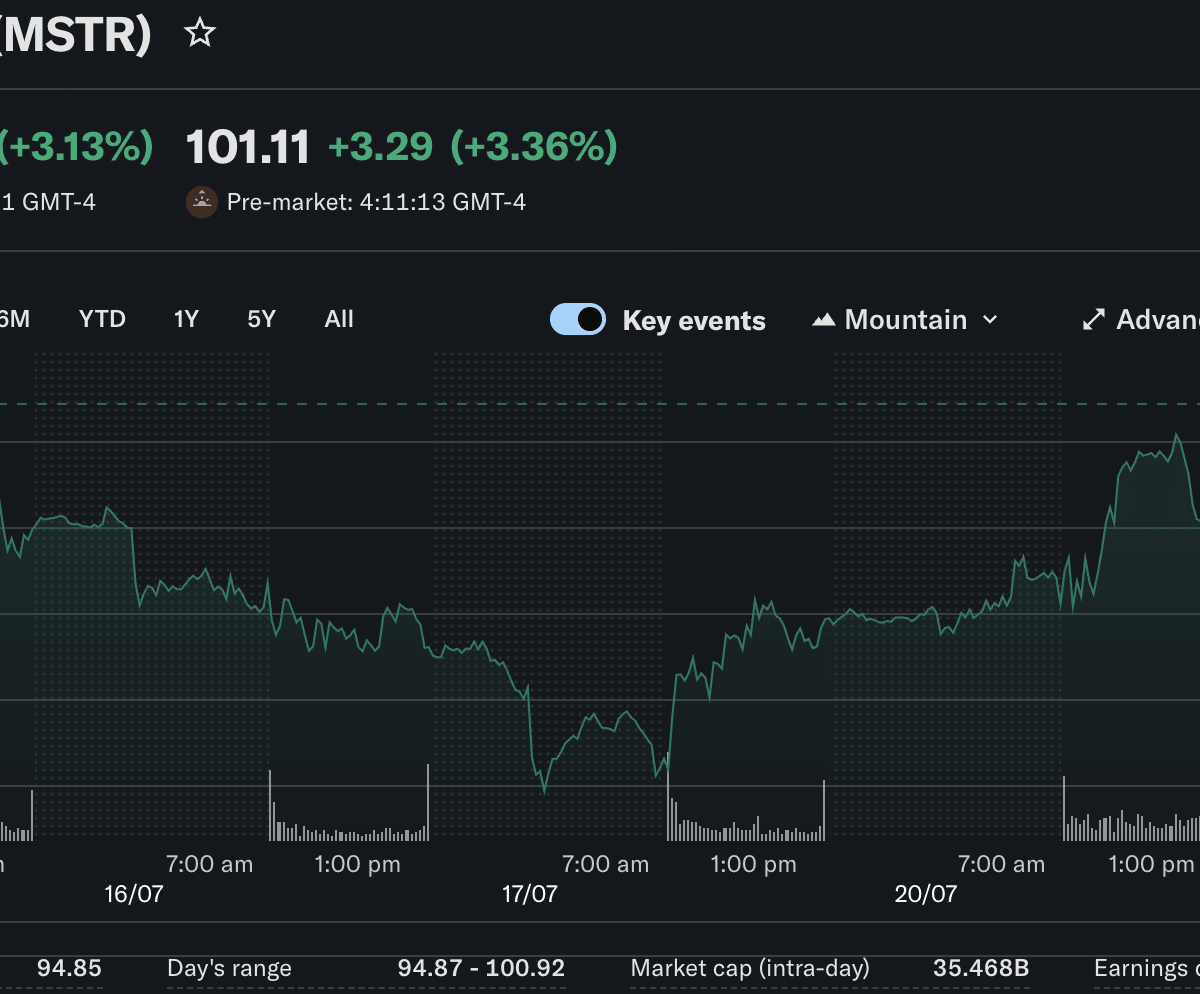
In Bitcoin news today, Michael Saylor, Executive Chairman of Strategy (Nasdaq: MSTR), posted on X on July 18, 2026, that corporate adoption of Bitcoin is ‘necessary’ and ‘inevitable’ for BTC to succeed as a global monetary network.
The remarks landed as MSTR shares rose 3.13% and BTC-USD climbed 2.60% on the day, according to Simply Wall St’s Yahoo Finance page.
Strategy has increased its USD Reserve by $225 million. As of 7/19/2026, we hodl ₿843,775 in our BTC Reserve and $3.2 billion in our USD Reserve. $MSTR $STRC https://t.co/sci7bZHzsy
— Michael Saylor (@saylor) July 20, 2026
The central question this article addresses is: is Saylor’s corporate adoption thesis a structural demand argument for Bitcoin’s price floor, or aspirational positioning by the world’s largest corporate BTC holder?
This news dropped as Bitcoin surged +3.5% overnight, climbing back above $66,000, and is currently trading at $66,250. Daily trading volume for BTC sits at $32.9Bn.
Bitcoin News Today: What Strategy Is Actually Arguing

Saylor’s claim is not simply that more companies will buy Bitcoin. His argument, as reported by Simply Wall St on July 20, 2026, is that corporate adoption is essential for Bitcoin to function as global money, linking Bitcoin’s long-term success as a currency to deeper engagement from corporations. That framing makes corporate adoption a structural prerequisite, not a nice-to-have – for Bitcoin to function as global money.
Strategy sits at the center of this narrative by design. The company has tied its entire balance sheet and brand identity to Bitcoin, functioning not just as a holder but as an active advocate shaping how other corporations think about institutional Bitcoin exposure. As Simply Wall St noted, that dual role means Saylor’s public commentary is inseparable from the investment thesis underpinning MSTR itself.
The editorial brief cites Saylor data showing that the number of public companies holding Bitcoin has increased in recent years, rising from earlier counts to 194 by Q4 2025.
Approximately 125 exchange-traded funds or exchange-traded products now hold Bitcoin, with roughly 1.4 million BTC sitting inside those vehicles, according to the same Q4 2025 earnings call data.
Why the Corporate Adoption Count Matters for BTC Price
The price argument embedded in Saylor’s thesis is a supply-and-demand one. Corporate treasuries that buy and hold Bitcoin, rather than trade it, reduce available liquidity in the market.
Pair that with the Bitcoin held within ETF and ETP products, and the thesis presents recurring institutional demand as supportive of broader availability in the spot market. JPMorgan, in a note dated July 15, 2026, described Strategy’s cash positioning as constructive for Bitcoin amid uneven ETF demand.
This is the distinction retail investors should hold onto: Saylor’s thesis is structural and long-dated, not a near-term trading trigger. Growing Bitcoin treasury adoption by corporations removes coins from circulation over years, not days, and supports a higher long-run price regime by raising the effective demand floor.
For anyone wanting to jump on the Bitcoin price surge, ByBit has an ongoing $1,000 airdrop campaign exclusive for 99Bitcoins readers
Bull Case, Base Case, Bear Case for Corporate BTC Demand

- Bull case: Corporate adoption accelerates as more corporations treat Bitcoin as a longer-term asset allocation theme. Supply compression intensifies, providing structural support for BTC above current levels.
- Base case: Corporate adoption continues at a measured pace. ETF and ETP demand remains an important institutional channel. BTC benefits from a slowly rising demand floor, but no step-change in the price regime is expected in the near term.
- Bear case: Corporate adoption proves slower or more cautious than Saylor expects. Concentrated balance-sheet exposure at firms like Strategy amplifies drawdowns when BTC sells off. As Simply Wall St flagged, if other corporations are slower or more cautious in adopting Bitcoin than Saylor expects, Strategy’s positioning could leave it out of step with mainstream treasury and payment practices.
The bear case is not a dismissal of the thesis; it is a timing and concentration risk. Corporate treasuries absorbing BTC’s volatility on their balance sheets creates real financial exposure for those companies, and that exposure can become a forced-selling mechanism in severe drawdowns.
EXPLORE: The Next 1000x Crypto Gem Before It Lists on Binance
Bitcoin News Today: What to Watch Going Forward
In other Bitcoin news today, Simply Wall St has identified the most actionable signal for investors: watch whether Strategy backs Saylor’s thesis with concrete initiatives, new indexes, data products, or partnerships that give other corporations a practical framework for assessing Bitcoin adoption.
Equally important is how traditional financial institutions respond to their own treasury and payment policies. The positioning of major asset managers in Bitcoin ETFs offers a real-time read on whether institutional appetite is broadening or stalling.
If major banks move from custody services into actual balance-sheet exposure, that would validate Saylor’s inevitability argument with hard data rather than declared intent. Until then, the thesis is compelling, but still on trial.
DISCOVER: Best Meme Coin ICOs to Invest in 2026
The post Bitcoin News Today: Saylor Argues Corporate BTC Buying Could Set New Price Floor appeared first on 99Bitcoins.