


Against my better judgment, I made the error of checking out the comments under the trailer for Prime Video’s limited series Blade Runner 2099. Rookie mistake, I know, but I thought that surely someone would share my enthusiasm for Academy Award winner Michelle Yeoh and Euphoria breakout Hunter Schafer teaming up in an iconic cyberpunk world, right?
‘Blade Runner 2099’ teaser: Michelle Yeoh and Hunter Schafer team up and hunt rogue replicants
Instead, I was inundated with waves of comments bashing the show. Detractors called it “Temu Blade Runner” and claimed it felt nothing like Ridley Scott’s iconic 1982 film or Denis Villeneuve’s acclaimed 2017 follow-up. These arguments read like overprotective fans: people with such clear ideas about the titles they love that they can’t accept any vision that isn’t their own. That’s somewhat understandable to anyone who’s ever adored a franchise and worried about its future, but it’s simultaneously dismaying that fans who are presumably Blade Runner 2099‘s target audience would be so quick to dismiss it.
Far uglier comments veered into transphobia directed at Schafer, revealing what is likely the crux of so many naysayers’ fury about the series: They can’t stand a trans woman leading the next stage of a seminal sci-fi franchise.
Too bad for the transphobes. Blade Runner 2099 straight-up rocks, and Schafer is fantastic in it. So, unsurprisingly, is Yeoh. Between Yeoh and Schafer’s electric chemistry and astounding production design, Blade Runner 2099 proves the skeptics wrong and cements itself as a more-than-worthy addition to the franchise.
Blade Runner 2099 puts replicants on top.

Michelle Yeoh as Olwen in “Blade Runner 2099.”
Credit: Clay Enos / Prime
Created by Silka Luisa, Blade Runner 2099 flips the power dynamics of the prior Blade Runner films on their heads. In those movies, humans were in charge, while replicants performed menial labor and dangerous tasks like settling off-world colonies.
At some point, replicants must have realized, “Wait a minute, we’re stronger and more durable than our human overlords,” because by the time Blade Runner 2099 rolls around, they’ve taken control through an offscreen uprising.
Now, replicants hunt the humans who disobey them. The squad who does so has reclaimed the title of “blade runner,” turning their own worst fears into a power play.
Among the humans on the blade runners’ radar is Cora (Schafer), who’s hiding under a false identity. All she wants is to escape Los Angeles and get medicine for her paraplegic brother Elias (Lewis Gribben). To do so, she’ll have to undertake a dangerous mission: pose as a blade runner in order to find an artifact that could move humans back to the top of the food chain.
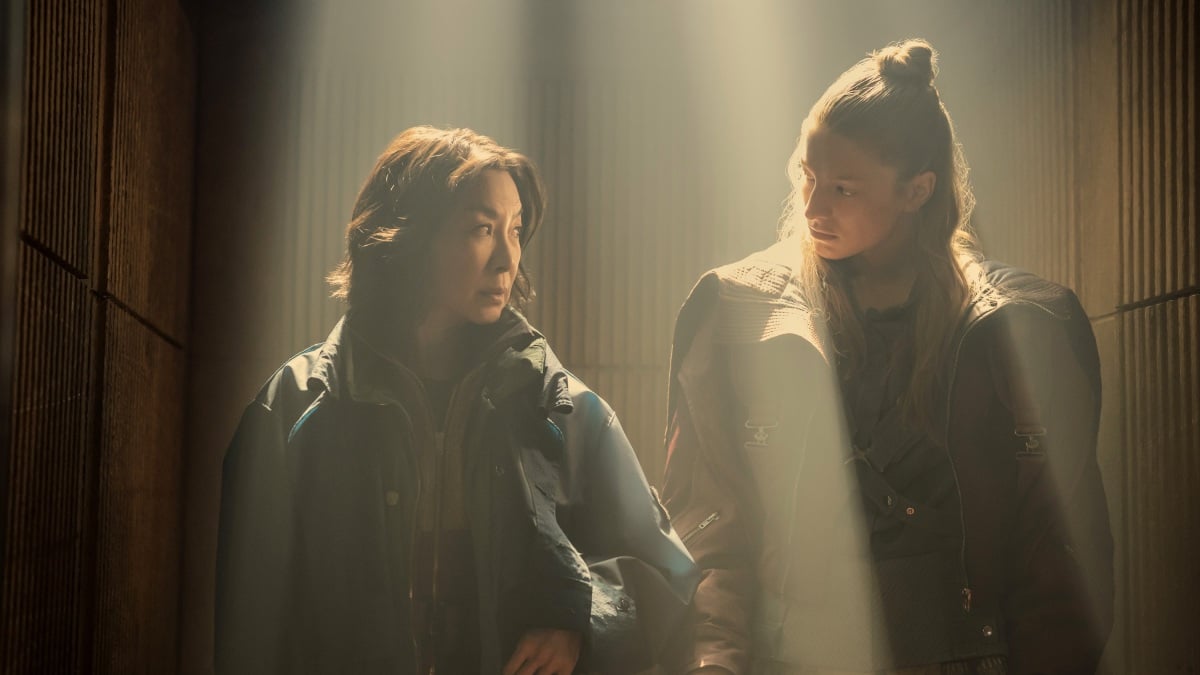
Hunter Schafer and Michelle Yeoh are brilliant badasses in Blade Runner 2099.

Hunter Schafer as Cora and Michelle Yeoh as Olwen in “Blade Runner 2099.”
Credit: Clay Enos / Prime
As Cora, Schafer faces a daunting task: play a human playing a blade runner. She absolutely nails the challenge.
Mashable Top Stories
Schafer’s Cora is determined yet downright terrified. During the early stages of her blade runner infiltration, she has to pass a number of security checks and bluff her way through serious bureaucratic procedures. Throughout it all, Schafer’s eyes are constantly on the move, always searching for an escape route should the need arise. The squirrelly nature of her performance emphasizes Cora’s very human survival instincts, but it also amps up the overall suspense of the series. With every paranoid dart of her eyes, you want to scream, “Stop acting so nervous and human! They’ll catch you!”
Yet there’s a flip side to Cora, one that Schafer switches into when Cora takes the infamous Voight-Kampff test designed to identify replicants. Here, Schafer is cold and hardened, almost soulless. The effect is chilling, yet Schafer threads just the slightest bit of humanity into the scene to remind you that Cora is bluffing. It’s an exhilarating line to walk, and Schafer treads it deftly throughout the season, bringing both sides of Cora together until she’s something new entirely.
Cora winds up working with replicant/veteran blade runner Olwen (Yeoh), whose hunt for a band of rogue replicants overlaps with Cora’s own quest. Yeoh gets to showcase her action bonafides in spades here, whether Olwen’s getting outnumbered in shootouts or going blow for blow in brutal hand-to-hand fights. Olwen’s competence makes for a nice foil with Cora’s more panicked inexperience, and despite some clunky fight scene editing, Yeoh’s status as an action legend remains strong.
But Olwen doesn’t just kick ass and take names. Like all replicants, she knows when she’s going to die, right down to the date. For her, that date is eight days away by the time Blade Runner 2099 kicks off. As much as Olwen claims to accept her expiration, Yeoh’s subtle melancholy hints that she craves more time, not to mention a more fulfilling life than hunting quarries day in and day out. Surely, there’s more to existence than that?
According to Blade Runner 2099, that “more” may just be Olwen’s partnership with Cora. Like its predecessors, the series interrogates what it means to be human, and whether replicants truly are so different from us after all. Blade Runner 2099 posits that companionship is what truly defines the human experience. Early in the series, Cora’s ally Bebeto (Dimitri Abold) tells her, “You’re so alone you’re not a person anymore. That’s why you can be [a blade runner.]”
Strangely, it’s in working with a blade runner that Cora begins to find a way out of her isolation, and it’s in working with a human (albeit one in disguise) that allows Olwen to grapple with her programmed mortality. Schafer and Yeoh are dynamite together, each bringing a distinct cool to their roles, but never sacrificing vulnerability in the process. Theirs is the kind of buddy cop dynamic you wish you could spend more time with, but alas, Blade Runner 2099 is confirmed to be a limited series.
Blade Runner 2099 is a technical marvel.

Hunter Schafer as Cora in “Blade Runner 2099.”
Credit: Clay Enos / Prime
Blade Runner 2099‘s central mystery is nothing to write home about: a hunt for a MacGuffin that leads to a convoluted series of twists and turns. But the places it takes Olwen and Cora? Those, I could write home about all day.
Production designers Paul Inglis and Chloe Arbiture conjure up astounding riffs on familiar scenes from Blade Runner’s Los Angeles, from its neon-soaked billboards spanning the sides of skyscrapers to the gargantuan pyramids that dwarf the buildings below. Even on the small screen, the scale of this world is enormous and awe-inspiring.
The street-level details sing, too. Blade Runner takes special care establishing the mechanisms of its cyberpunk city, building chase sequences around surveillance cameras and pod-shaped trams. Buildings are grimy and worn, bursting with decades of life and texture. In one standout sequence, Olwen and Cora visit a shop bathed in red light, where replicants don fake molds of bodies to simulate physical human experiences they’ll never have, like pregnancy. The bodies hang from meathooks, evoking a slaughterhouse. It’s unnerving and unforgettable, but most importantly, it fits right into a dystopian future where humans and replicants alike have never been more aware of their bodies or their limits.
Elsewhere, costume designer Helen Huang riffs on Blade Runner‘s legacy of great coats, with Olwen’s layered trench coat right at home alongside Deckard (Harrison Ford) and K’s (Ryan Gosling) fashion choices. The standout may just be Cora’s jacket, though. With its larger-than-life shoulders, it turns Cora into an imposing presence, making her look the part of blade runner, even if she’s not.
Tying the show together is composer Leopold Ross’s dazzling score. With its glittering synths and sultry saxophone, it’s the perfect companion to Vangelis’s work on the original Blade Runner. For music reasons alone, Blade Runner 2099′s credit sequence is simply un-skippable.
Each of these elements is a strong refutation of the comments that claim Blade Runner 2099 somehow doesn’t feel like Blade Runner. It’s simply impossible to take in its visuals, listen to its score, or witness its cyber-noir storytelling and think you’re witnessing anything but! Put aside the online conversation and actually watch the series, and your skepticism will soon be lost to time, like tears in rain.
Blade Runner 2099 is now streaming on Prime Video.
Recommended deals for you
HBO Max
—
top pick for premium content
Disney+
—
best for families
Peacock
—
low-cost choice for live sport