


Key Takeaways
- Michael Saylor says Bitcoin can grow 100-fold and become the foundation of global capital.
- He warns protocol changes could weaken scarcity, security, and economic protections.
- Saylor argues Bitcoin’s consensus rules must remain neutral for long-term adoption.
Bitcoin’s Success Brings a New Fight Over Its Rules
Strategy Inc. (Nasdaq: MSTR) Executive Chairman Michael Saylor warned that Bitcoin’s greatest challenge may come from internal governance disputes as the network grows from a digital asset into a potential foundation for global capital markets.
In a July 28 series of posts on X, Saylor maintained that Bitcoin has reached a major stage of adoption but now faces pressure over the rules that define its economic system. He framed the debate around whether protocol changes could alter the network’s structure and the incentives supporting participants.
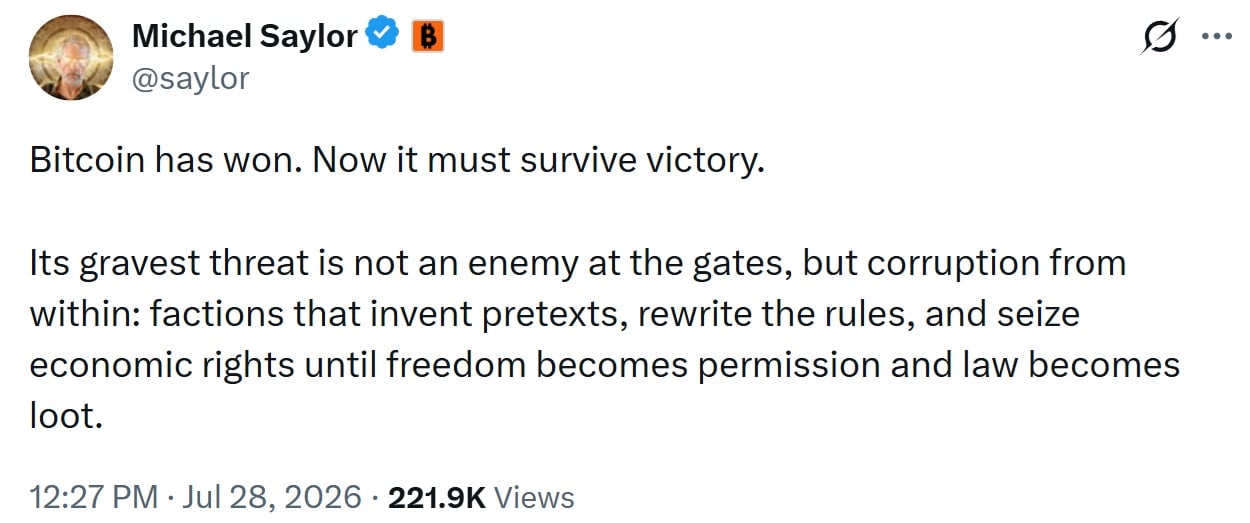
“Bitcoin has won. Now it must survive victory,” Saylor wrote, describing internal rule changes as the primary threat rather than outside competition. He cautioned that groups could “invent pretexts, rewrite the rules, and seize economic rights” if they gain influence over Bitcoin’s governance process.
The Strategy chairman described the protocol’s governing framework as the foundation of its monetary structure: “Bitcoin’s consensus rules are its constitution. They define property, scarcity, settlement, and power.” He emphasized that changing that framework to benefit any specific faction could affect the broader ecosystem and the rights of participants.
The comments reflect Saylor’s broader long-term outlook for BTC as a potential global digital capital asset that could expand beyond traditional investment markets and become a larger part of institutional finance.
Protocol Changes Could Alter Bitcoin’s Incentives
Saylor pointed to Bitcoin’s long-term upside, saying the crypto asset could grow 100-fold and become a foundation of global capital.
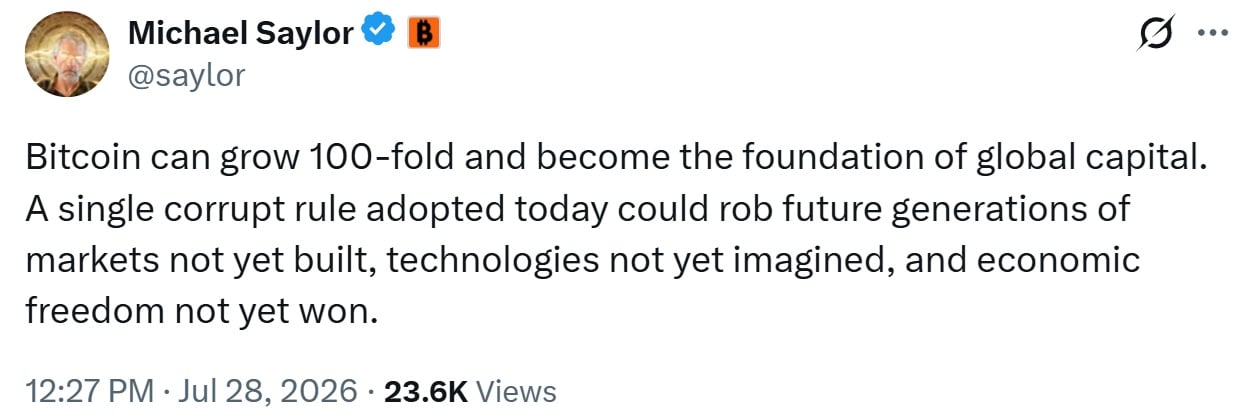
He connected that potential growth with the risks of changing Bitcoin’s rules: “A single corrupt rule adopted today could rob future generations of markets not yet built, technologies not yet imagined, and economic freedom not yet won.”
Saylor identified BIP-110, covenant-related features, and larger block proposals as examples of changes he believes could create risks for Bitcoin’s ecosystem. His concerns center on whether technical upgrades could allow groups to impose new costs, tradeoffs, or risks on network participants.
He also argued that transaction restrictions could limit miner choice, larger blocks could weaken blockspace scarcity while increasing validation costs, and covenant systems could add complexity and new attack surfaces.
The debate over Saylor’s BIP-110 criticism has become part of a wider discussion over whether Bitcoin should prioritize new functionality or preserve its existing settlement model. The ongoing Bitcoin’s BIP-110 debate reflects disagreements among developers, miners, and users over how network upgrades should be evaluated.
Mining Economics and Institutional Adoption Raise the Stakes
The Bitcoin advocate also connected protocol decisions to the network’s long-term security model, pointing to the declining block subsidy and the growing importance of transaction fees.
“Miners put capital at risk to secure Bitcoin. Their subsidy halves every 210,000 blocks, so fees must carry more of the security burden,” Saylor remarked.
The Strategy chairman noted that Bitcoin’s security model depends on miner incentives as block rewards decline. Governance decisions also affect exchanges, custodians, applications, investors, and companies holding Bitcoin. The growth of corporate Bitcoin adoption has increased institutional focus on predictable rules and network stability.
He also raised concerns about governance capture, arguing that allowing political influence to determine consensus changes could create ongoing conflicts over control of the protocol.
“Protocol warfare becomes permanent,” Saylor concluded, warning that prolonged disputes could push away capital, slow innovation, weaken security, and prevent Bitcoin from reaching its full potential.