

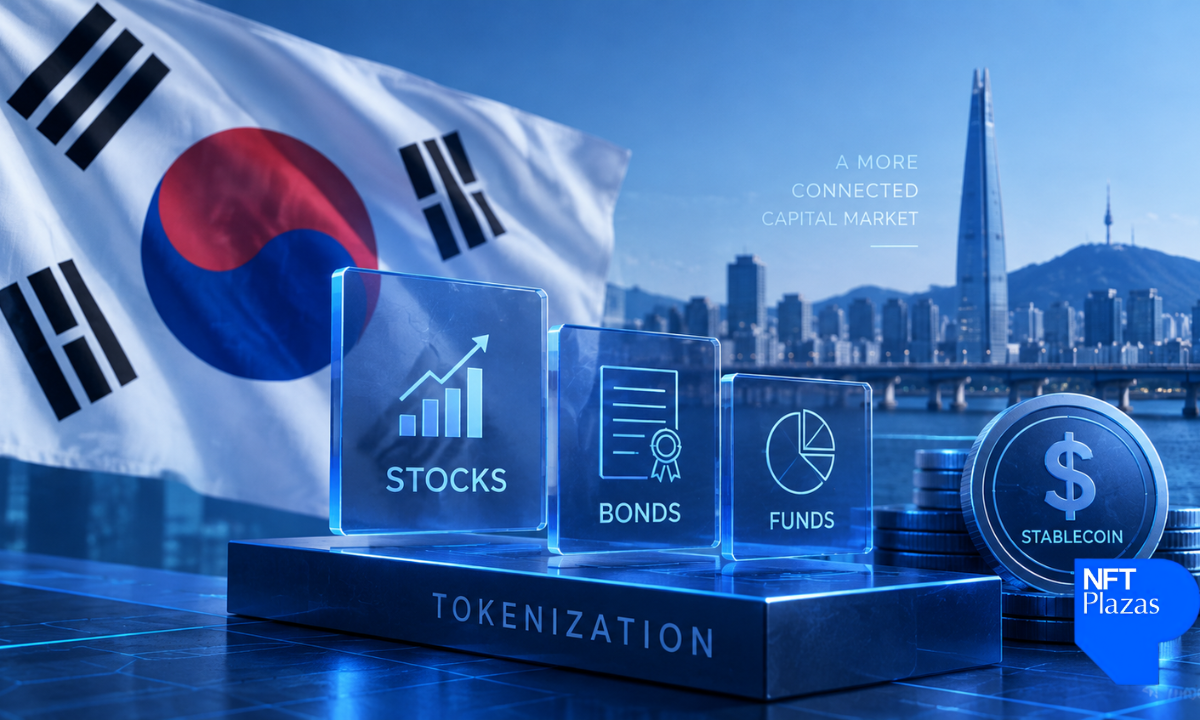
South Korea is preparing to move traditional securities onto blockchain infrastructure, with regulators unveiling a three-phase roadmap that could eventually connect tokenized stocks, bonds and funds directly to stablecoin-based payments.
The Financial Services Commission (FSC) announced the plan on September 4 following a public-private consultation on securities tokenization. The first stage is scheduled to begin on February 4, 2027, when amendments to the Act on Electronic Registration of Stocks and Bonds are expected to take effect and formally recognize tokenized securities as digital forms of securities.
The initiative goes beyond South Korea’s existing security token offerings (STOs), which have largely focused on fractional investment products. Regulators want to establish infrastructure capable of supporting the tokenized issuance and circulation of conventional securities, including stocks, bonds and investment funds.

South Korea Launches Blockchain Roadmap for Tokenized Stocks and Bonds
Seoul Sets a Three-Phase Roadmap
The first phase, beginning in February 2027, will focus on a limited group of assets. These include privately pooled money market funds and bonds reserved for institutional investors, unlisted stocks held through trust structures, and publicly offered fractional investment securities.
This initial rollout is designed to establish the legal and technical foundation for tokenized securities before regulators open the system to a wider range of assets.
Phase two will expand tokenization to all publicly offered securities. That would mark a much broader shift, bringing blockchain-based infrastructure into mainstream securities markets rather than limiting it to specialized investment products.
The third phase targets the payment layer. Regulators ultimately want to establish an on-chain payments infrastructure linked to stablecoins, potentially allowing tokenized securities and their payments to operate through connected digital systems.
However, Seoul has not committed to fixed dates for the second and third phases. Their rollout will depend on the results of the initial tokenization program, technological adoption by financial institutions and the progress of pending stablecoin legislation.
New Rules for Investors and Issuers
Alongside the roadmap, the FSC released model standards for fractional investment.
Individual subscriptions will be capped at the lower of 30 million won, roughly $22,000, or 5% of an offering’s total issuance. Retail investors will also face limits on their purchases of tokenized securities traded over the counter, with annual net purchases capped at 100 million won, or about $74,000, per exchange.
The framework is intended to expand access without allowing retail exposure to grow unchecked as tokenized markets develop.
Financial firms will also face capital and technology requirements. Entities managing tokenized securities accounts will need at least 4 billion won, approximately $2.9 million, in equity capital, along with dedicated personnel responsible for account management, internal controls and IT security.
The Korea Securities Depository (KSD) is working on technical requirements that securities firms will have to satisfy before connecting to the shared infrastructure. The FSC also plans to propose revisions to subordinate rules under the Financial Services and Electronic Registration Acts by the end of September.
Why South Korea Is Moving Now
The roadmap arrives as blockchain infrastructure increasingly moves into conventional financial markets.
South Korea has one of Asia’s most active retail investment cultures and a large cryptocurrency user base. Its regulators have increasingly focused on creating rules that bring digital assets and blockchain-based financial products into the regulated financial system rather than allowing them to develop entirely outside it.
The country’s approach also fits into a broader Asian push toward blockchain-based financial infrastructure. Japan is exploring a blockchain settlement system for stocks and government bonds, while financial centers such as Singapore are developing regulatory frameworks for stablecoins.
South Korea’s plan is notable because it connects the two developments. Rather than treating tokenized securities and stablecoins as separate markets, regulators are ultimately considering an infrastructure in which securities issuance, trading and settlement can be digitally connected.
That could potentially reduce settlement friction, automate parts of transaction processing and create more direct links between asset ownership and payment.
The Biggest Test Will Be the Infrastructure
Moving securities onto blockchain, however, does not automatically make financial markets more efficient.
The technology introduces its own challenges, including cybersecurity, smart-contract vulnerabilities, liquidity management and questions over how tokenized assets should be supervised when transactions cross borders.
That makes the phased structure of South Korea’s roadmap significant. Regulators are starting with a narrower group of securities rather than immediately putting the entire stock and bond market on-chain.
The first phase will therefore serve as a test of whether financial institutions can integrate distributed-ledger infrastructure into existing market operations without compromising investor protection or financial stability.
If the system works as intended, the next step could be far more consequential. Tokenization would move from a niche application used for fractional investments into a broader architecture for conventional securities.
South Korea’s end goal is even larger: a digital capital market in which tokenized stocks, bonds and funds can eventually settle through blockchain-based payment infrastructure connected to stablecoins.
For now, February 2027 is the key milestone. But the roadmap signals that Seoul is no longer treating security tokens as a peripheral experiment. It is positioning blockchain as a potential foundation for the next generation of its regulated capital markets.